🧱 PV130 Self-Propelled Crawler Vacuum Handler with Fork-Lift Capability
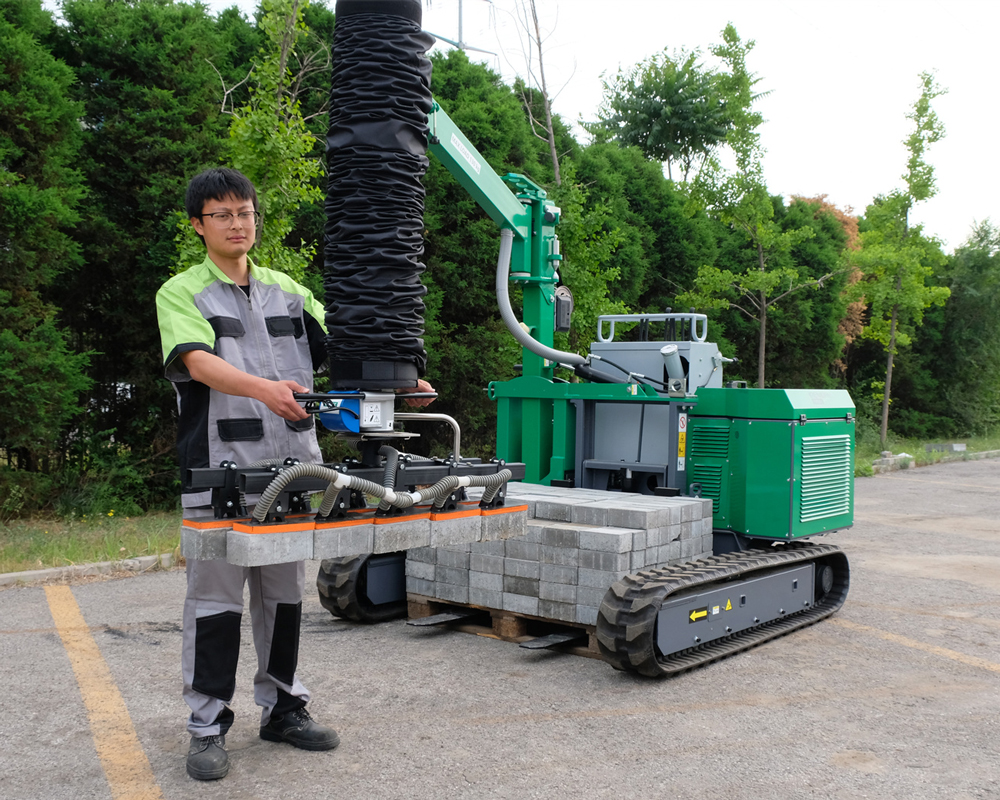
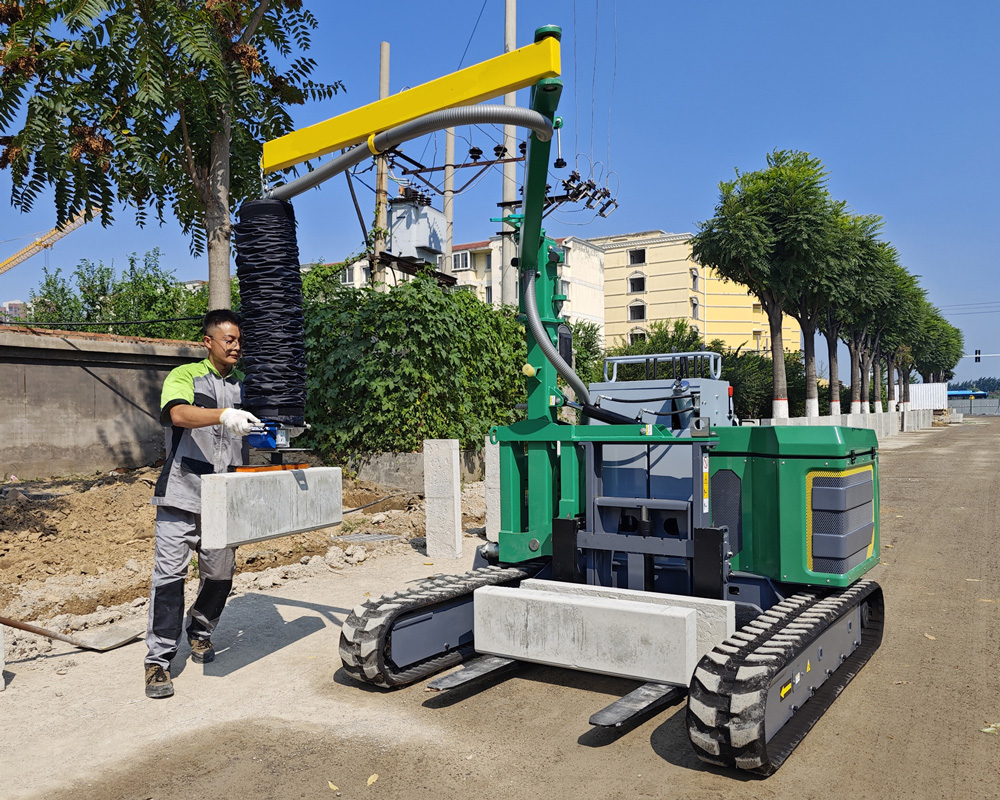
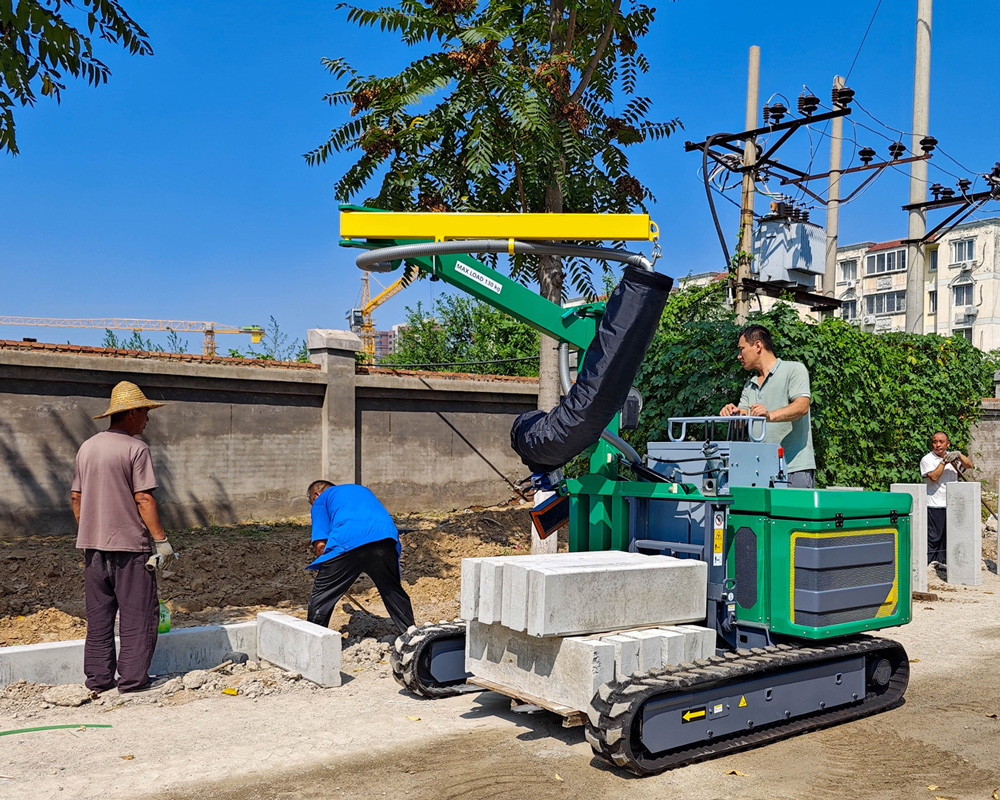
The PV130 is a self-propelled, crawler-mounted vacuum handling machine designed for the transport and installation of curbs, precast concrete elements, natural stone slabs, and other heavy block materials. It integrates pallet transport, crawler mobility, a hydraulic boom, and vacuum lifting capabilities into a single unit. It can transport a full pallet of materials across the job site and, upon reaching the installation area, use its vacuum suction cup to lift, transfer, position, and install individual components—thereby eliminating the need for repetitive coordination between forklifts, cranes, and manual labor.
🎯 Handles Material Transport, Lifting, and Installation in One Go
Traditional curb or stone installation often requires a forklift to transport materials, followed by separate lifting equipment or manual labor for final positioning. The PV130 features a pallet carrier capable of holding up to 1,600 kg of material and can travel autonomously with the load. Once at the work site, it uses its boom and vacuum suction cup to install components one by one. This makes it ideal for continuous installation workflows and projects—such as municipal, road, and landscaping works—that require frequent material relocation.
💪 Standard 130 kg Lifting Capacity; 240 kg Version Available
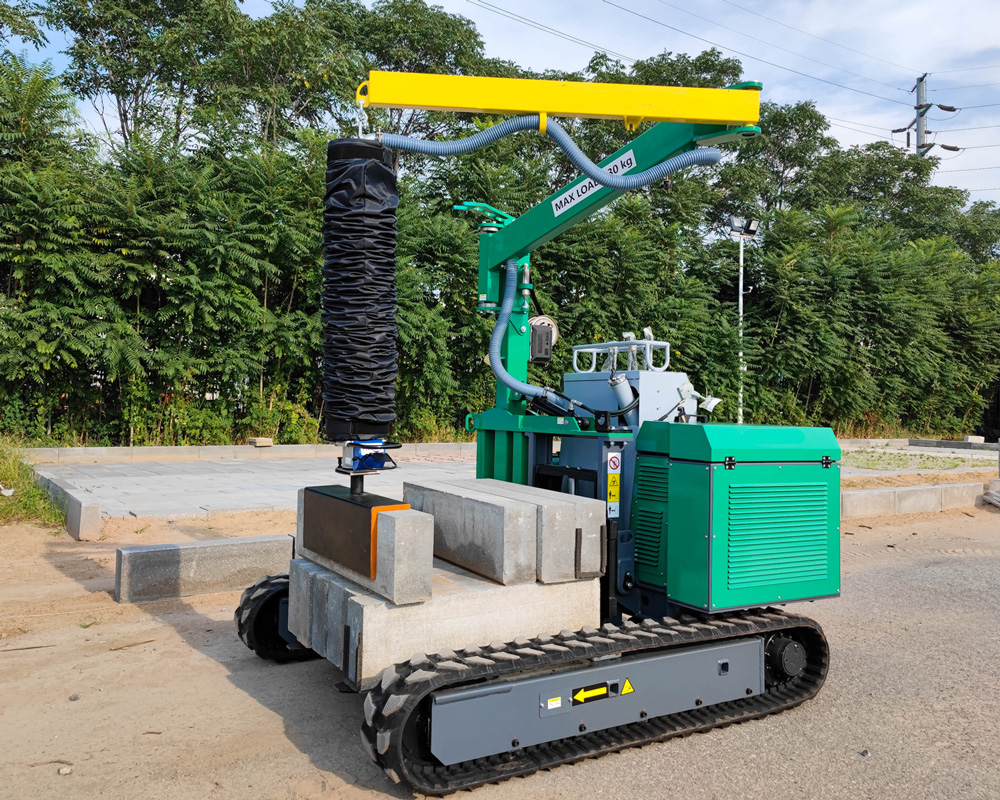
The standard vacuum lifting capacity is 130 kg, suitable for a wide range of standard curbs, natural stone slabs, concrete panels, and precast blocks; a 240 kg capacity version is available for heavier components. Actual lifting capacity depends on factors such as the component's surface flatness and density, suction cup size, vacuum seal integrity, and center of gravity; a test lift should be performed prior to actual operation.
🦾 3.0-Meter Hydraulic Boom Extends Installation Reach
The boom measures approximately 3.0 meters in length and is controlled via a hydraulic system that ensures balance and precision. Once the machine is stabilized, it can lift components from the pallet and move them to curbs, trenches, paved surfaces, or specific installation points. Compared to manual lifting, the hydraulic boom significantly reduces physical strain and offers greater control during the component positioning process.
📦 1,600 kg pallet load capacity for continuous installation
The pallet carrier supports loads of up to 1,600 kg and accommodates pallets up to 1,320 mm wide. It allows multiple curbs or precast elements to be transported into the work zone in a single trip, minimizing the need for the equipment to shuttle back and forth to the material stockpile. When loading the pallet, ensure the center of gravity remains stable, the weight is evenly distributed, and the equipment's rated load capacity is not exceeded.
🚜 Rubber tracks suitable for construction sites and rough terrain
Equipped with a rubber track undercarriage, the machine offers excellent traction on gravel, compacted soil, uncured road surfaces, and generally uneven terrain. Compared to steel tracks, rubber tracks are gentler on finished paving and concrete surfaces, making the unit ideal for maneuvering within municipal road projects, landscaped parks, residential developments, and active construction sites.
🧩 Foldable boom for space-constrained sites
The boom can be folded away, resulting in a more compact footprint when the machine is not in use. Its smaller profile facilitates maneuvering, transport, and storage—particularly in areas such as sidewalks, road edges, residential zones, garden paths, and enclosed construction sites. The boom can be quickly folded by a single operator, reducing setup and teardown times.
🔄 Quick-change vacuum suction system for various components
The PV130 features a quick-change vacuum suction system, allowing the suction pad to be swapped based on the specific workpiece. Curbs, natural stone slabs, precast concrete elements, and other block materials vary in size, surface texture, and center of gravity; using the appropriate suction pad ensures stable handling. Suction pads can also be customized to match the shape and dimensions of specific components.
🧱 Curb installation: A primary application for the PV130
Road, municipal, and landscaping projects often involve large numbers of heavy curbs that require continuous installation. The PV130 can transport a full pallet of curbs into the work zone and then lift and position them one by one, significantly reducing the need for manual lifting and repetitive machinery movement.
This "carry-and-lay" construction method—where materials are transported on the vehicle itself—offers distinct advantages for long-distance, continuous paving projects.
🏗️ Handling and Installation of Precast Concrete Components
The equipment is suitable for handling concrete slabs, precast blocks, small trench components, and other regular precast units. When component surfaces are suitable for vacuum suction, this method eliminates the need for the repetitive rigging required by traditional wire-rope lifting; this boosts efficiency in loading, unloading, and positioning while preventing edge damage caused by sling compression.
🪨 Paving with Natural Stone Slabs and Landscape Stone
Natural stone is typically heavy and requires careful surface protection. When equipped with the appropriate suction pads, the PV130 can handle and position natural stone slabs, granite pavers, and landscape stones. For stones with rough, porous, or irregular surfaces, a vacuum seal test should be performed to ensure stable adhesion before actual lifting begins.
💧 Installation of Drainage Channels and Trench Components
Precast drainage channels, trench covers, and related concrete components are often installed continuously along roadways, demanding high precision in positioning and a steady construction pace. The PV130 can transport materials along the trench line and install components one by one using its lifting boom, thereby reducing the need for frequent repositioning of large lifting machinery.
🧱 Construction of Retaining Wall Blocks and Landscape Walls
Retaining wall blocks, landscape wall components, and large masonry units can also be handled via vacuum lifting, depending on their individual weight and surface characteristics. The hydraulic boom facilitates precise component positioning and reduces the physical strain of manual handling; this is particularly beneficial for installation tasks requiring repeated adjustments and alignment of joints.
👷 Single-Operator Capability Reduces Labor Dependency
One of the equipment's design goals is to minimize reliance on multiple manual handlers for paving operations. When dealing with regular components—and provided that materials are organized, access paths are clear, and the site is well-managed—a single operator can execute the entire workflow, including moving the equipment, engaging suction, lifting, and positioning.
However, for operations on slopes, in complex traffic environments, or involving heavy components, auxiliary personnel should still be assigned in accordance with on-site safety requirements.
⚡ Air-cooled version: Suitable for standard municipal and paving projects
The air-cooled version is equipped with a Hatz silent diesel engine (13 HP / 9.6 kW) featuring electric start and an hour meter. Its transport dimensions are approximately 2230 × 1850 × 2100 mm, with an operating weight of about 1400 kg. With its relatively compact design, this version is ideal for standard curb installation, municipal works, and landscape paving projects.
💧 Water-cooled version: Offers greater power reserve
The water-cooled version features a Yanmar three-cylinder water-cooled engine (20 HP / 14 kW) equipped with a tachometer and fuel gauge. Its transport dimensions are approximately 2300 × 1900 × 2100 mm, with an operating weight of about 1600 kg. This configuration is the preferred choice for projects requiring extended operating times or a higher power reserve.
🚚 Compact size: Easy truck transport and site-to-site transfer
The PV130 features a compact overall design, allowing for easy transport between job sites using suitable small or medium-sized vehicles. For municipal contractors, road construction crews, and landscaping teams—who often need to move equipment frequently between multiple projects—ease of transport and minimal on-site storage requirements are crucial factors.
⚠️ Verify surface condition before vacuum lifting
Vacuum suction relies on a reliable seal to generate holding force. Before lifting, clean the suction area to remove mud, dust, and standing water, and ensure the workpiece surface is free of severe cracks, loose layers, or significant damage. For porous concrete, rough natural stone, or irregular components, perform a test lift to confirm vacuum stability before proceeding with actual handling.
🛡️ Precautions for Carrying Pallets and Vacuum Lifting Operations
When transporting a pallet, ensure the material is securely fastened and the center of gravity is controlled; reduce speed when traversing slopes or soft ground. Personnel must not stand beneath suspended loads during lifting operations. After replacing suction cups, inspect the connections, seals, and vacuum system status. Do not attempt to lift any component that exceeds the rated capacity of the current vacuum lifting configuration.
📌 Model and Specification Details
The current product model is designated as PV130 (noted as CVP130 in original documentation). Technical specifications are based on provided data, including a 1,600 kg pallet load capacity, a 130 kg standard vacuum lifting capacity (with a 240 kg optional version available), a 3.0 m boom, and a choice of air-cooled or water-cooled power configurations; the final delivered product is subject to the officially confirmed technical specifications.
Actual vacuum lifting capacity, handling efficiency, and installation results depend on specific site conditions and equipment technical requirements, as factors such as component weight, surface material, suction cup specifications, vacuum seal integrity, site slope, and operating methods may vary.
📊 Key Technical Specifications
| Parameter | Value |
|---|
| Basic Parameters |
|---|
| Model | PV130 |
| Equipment Type | Self-propelled, crawler-mounted vacuum lifter with integrated pallet transport |
| Primary Application | Handling and installation of curbs, concrete components, natural stone slabs, drainage channels, and retaining wall elements |
| Boom and Vacuum Lifting System |
|---|
| Boom Length | 3.0 m |
| Standard Lifting Capacity | 130 kg |
| Optional Lifting Capacity | 240 kg |
| Boom Balancing | Hydraulic balancing |
| Suction Cup System | Quick-change vacuum suction cup system |
| Custom Suction Cups | Customizable based on workpiece shape and dimensions |
| Pallet Transport System |
|---|
| Pallet Load Capacity | 1600 kg |
| Max. Pallet Width | 1320 mm |
| Transport Method | Self-propelled with pallet load |
| Chassis and Mobility |
|---|
| Chassis Type | Rubber tracks |
| Terrain Adaptability | Suitable for construction sites, gravel, compacted soil, and generally rough terrain |
| Equipment Features | Compact design; foldable boom; convenient for narrow sites and daily relocation |
| Air-Cooled Power Version |
|---|
| Engine | Hatz silent diesel engine |
| Power | 13 HP / 9.6 kW |
| Start & Instrumentation | Electric start, hour meter |
| Transport Dimensions | 2230 × 1850 × 2100 mm |
| Machine weight | 1400 kg |
| Water-cooled engine version |
|---|
| Engine | Yanmar 3-cylinder water-cooled engine |
| Power | 20 HP / 14 kW |
| Instruments | Tachometer, fuel gauge |
| Transport dimensions | 2300 × 1900 × 2100 mm |
| Machine weight | 1600 kg |
| Typical applications |
|---|
| Curbstone laying | Municipal roads, park roads, sidewalks, and landscape paths |
| Concrete components | Precast concrete slabs, block elements, and small precast parts |
| Natural stone | Natural stone slabs, granite slabs, and landscape paving stones |
| Drainage works | Drainage channel components, trench covers, and related precast parts |
| Retaining wall construction | Retaining wall blocks, precast wall elements, and other heavy block materials |


 small bulldozer
 Medium bulldozer
 Large bulldozer
 mini excavator
 small excavator
 medium excavator
 Large excavator
 wheeled excavator
 small loader
 Medium loader
 Large loader
 skid steer loader
 backhoe loader
 Single drum vibratory roller
 Double drum roller
 tire roller
 mini roller
 landfill compactor
 Small pipelayer
 Medium pipelayer
 Large pipelayer